We're excited to share some of the wins and hurdles from 2025 for our Spaceship Voyager portfolios along with a look ahead at what 2026 might hold.
Thanks for being on this journey with us, we really appreciate having you as part of the Spaceship Voyager community.
AI, AI, AI
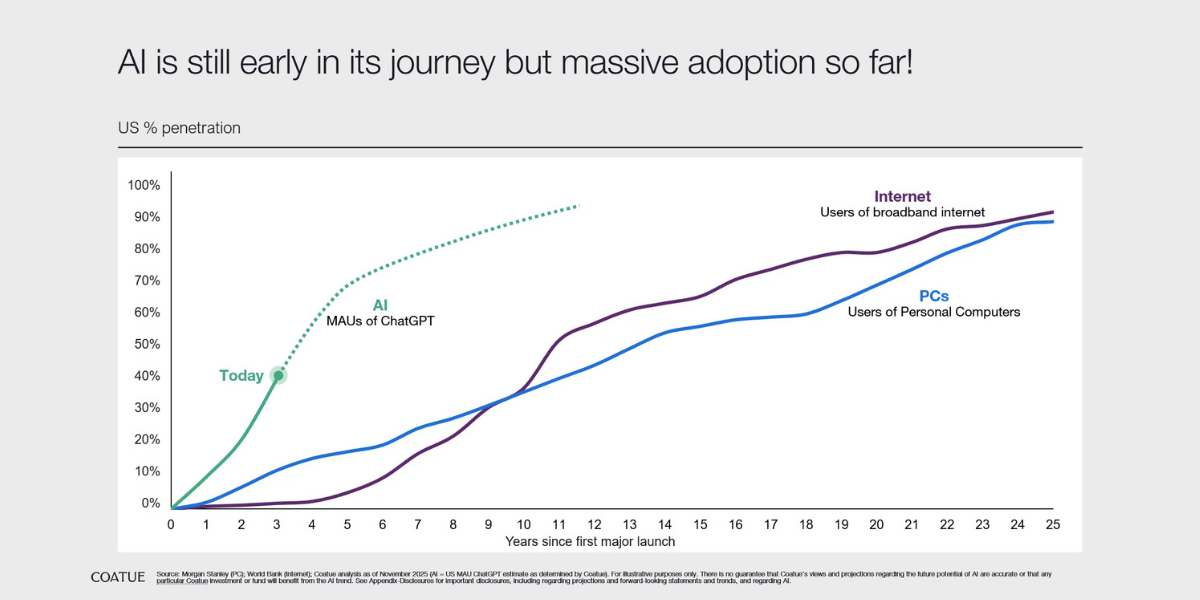
We get it, everyone's a bit Artificial Intelligence fatigued at this point but ignoring it would have been costly, AI wasn't just a theme this year; it was the dominant force driving equity market returns.
Why does it matter so much? Because the money flowing into AI is huge and with that comes real potential for both major disruption and massive opportunity.
Whoever builds the first truly capable AI assistant, one that can actually think, understand, and get stuff done could end up owning the digital economy: shopping, ads, payments, even your calendar. That's why every big tech company is racing to get there.
It's not just one market, it's all of them.
Bubble, bubble, toil and trouble
Is AI in a bubble? Not just yet. Sure, it could head that way eventually, but right now demand's running way ahead of supply. It's difficult to call something a bubble when customers cannot access capacity to meet their needs.
We're watching two things closely:
End-user adoption – are real customers actually using this stuff at scale?
Backlog growth – are future contracted revenues keeping up with all this capex?
So far, the answer has been yes. Current increases in capital expenditure are being supported by rising backlogs — that is, future contracted revenue. For example Google Cloud's backlog increased 82% year-over-year, reaching $155 billion at the end of the third quarter.
That means most companies aren't speculating; they're investing against already signed customer demand.
Instead of debating whether we're in a bubble, we're focusing on real AI use cases — where value is likely to be created, who's positioned to capture it, and how much will ultimately flow to consumers.
Source: Coatue November 2025 update. Past performance is not indicative of future results.
What did well
Our top performers this year were unsurprisingly, mostly AI-related. What's especially satisfying is that out of top eight performers, three were new ideas added in 2025:
- Applovin (top five)
- Constellation Energy (sixth)
- Broadcom (eighth)
All joined the portfolio in 2025 and made their way to the top of the leaderboard. It's always nice when early calls line up with where the world is actually going.
Top five performers
Share price returns below are for the period 1 January 2025 to 31 December 2025. These are not annualised figures.
1. Palantir*
Technology - Software | Big data analytics and AI-powered decision platforms for governments and enterprises.
Surging demand for its AI platforms and a fast-growing commercial business finally got the market to value Palantir like a real software company, not a lumpy contractor though we exited later in the year when that enthusiasm looked overdone.
Palantir rose 108% in 2025
2. Cloudflare
Technology - Software | Provides cloud-based cybersecurity and web performance services to protect and accelerate internet applications.
Its focus on the network edge and AI-first security turned Cloudflare into the internet's go-to gatekeeper, helping its revenue growth reaccelerate over the year.
Cloudflare rose 80% in 2025
3. Google
Communications - Media | Global tech giant that offers search, Youtube, Gemini with 9 products with over a billion users.
Cast as the AI underdog with fears chatbots would kill search, Google surprised as paid search kept growing and it flexed its full-stack muscle, chips, cloud, models, and nine products with over a billion users.
Google rose 63% in 2025
4. Applovin
Communications - Media | Mobile app and marketing platform company that provides software to help app developers grow, monetise, and analyse their apps.
Early integration of AI into their AXON ad engine boosted monetisation and conversions, supporting expansion from in-app game ads into the larger e-commerce advertising market.
Applovin rose 71% in 2025
5. Taiwan Semiconductor
Technology - Semiconductors | World's leading dedicated chip foundry, manufacturing advanced semiconductors for major global customers like Apple, Nvidia, and AMD.
Returns benefited from the company's position at the center of AI chip production, with robust demand for cutting-edge nodes (3nm and below) from key customers such as Nvidia.
Taiwan Semiconductor rose 54% in 2025
*We have sold the position
What didn't go so well
Our worst performers were a mixed bag, but the common thread was underperformance in holdings where issues proved structural rather than cyclical, often driven by intensifying competition which ultimately led us to exit the positions.
We exited Illumina earlier in the year, and naturally, it rallied afterward (classic). Still, that move was based on long-term conviction around research and development budget cuts and competition concerns. We also exited Lululemon and Enphase on rising competitive concerns. Both have continued to drift lower as markets moved higher, so those calls have already gone some way toward fixing earlier mistakes.
To be fair, the worst decisions weren't what we bought, but what we didn't buy that went up the most. In other words, the real pain is the opportunity cost of missing stocks that multiply in value and could have significantly boosted overall returns. We considered Robinhood and then politely declined only to watch it rocket. Robinhood doesn't show up as a detractor, but in opportunity-cost terms, given the share price more than doubled it was a bigger miss than the bottom performers listed below.
Bottom five performers
Share price returns below are for the period 1 January 2025 to 31 December 2025. These are not annualised figures.
1. Nuix
Technology - Software | Develops investigative analytics tools for cybersecurity, legal, and regulatory use.
Nuix was a round trip for us, with the share price falling sharply after rising the previous year as revenue and sales momentum kept getting pushed out, even though the software remains very sticky with customers. A sudden CEO departure was unsettling, but we think he largely completed the turnaround, and we're hopeful that new leadership with deeper enterprise sales experience can refocus the business on delivering stronger growth.
Nuix fell 72% in 2025
2. Oracle
Technology - Software | A multinational technology company known for enterprise software, cloud infrastructure, and database systems.
Investors began to doubt how much Oracle could really benefit from the OpenAI wave, especially as Google's Gemini made headlines leading investors to reassess potential AI leadership. We still think its services are sticky, and that Oracle's role as the core database for enterprise gives it a solid base to build a cloud business that benefits from AI demand.
Oracle fell 28% in 2025
3. Illumina*
Health Care - Life science equipment | A global leader in DNA sequencing and genomics used in research, diagnostics, and precision medicine.
Illumina's instrument sales have been hit by weaker research funding and lab/biotech budget cuts, and on top of China-related restrictions we saw signs of structural shifts in its market, which ultimately led us to exit the position.
Illumina fell 41% in 2025
4. Lululemon*
Consumer Discretionary | A premium athletic apparel brand focused on performance wear and lifestyle products.
Soft sales growth sharpened our concerns about rising competition from brands like Vuori and Alo, and given those structural pressures we chose to exit the position.
Lululemon fell 30% in 2025
5. Enphase*
Energy - Renewable Energy | Develops microinverter-based solar and energy storage systems for residential and commercial use.
Policy uncertainty around solar rebates was a headwind, but the bigger issue was mounting competitive pressure. Tesla's new Powerwall 3, an integrated battery-plus-inverter with compelling economics, started taking share in the U.S squeezing Enphase's core market, which was a key reason we chose to exit.
Enphase fell 50% in 2025
*We have sold the position
What this means for 2026 trends
Looking ahead to 2026, one thing's clear, AI is still the main event.
Demand across the AI stack from chips to data centers to energy is still running hot, and supply is scrambling to keep up. Companies keep revising their timelines, pushing out when they think things will finally balance, simply because demand keeps coming in stronger than expected.
Beyond AI, two areas we're particularly excited about are robotics and fintech:
Robotics
Falling hardware costs, better sensors and rapid advances in AI are turning what used to be "science projects" into real products — robots that can work in warehouses, factories, healthcare and even the home.
Fintech / tokenisation
We see real promise in blockchain, stablecoins and the potential tokenisation of real-world assets, where everything from government bonds to private credit and infrastructure could trade and settle on modern rails, opening up new markets, lowering costs and creating more liquid, programmable forms of ownership.
We should see some interesting IPOs soon. It's kind of surprising, given all the AI hype, that more AI companies haven't listed yet, though a big IPO – SpaceX – is rumoured to list this year. When a lot of big name IPOs occur, it's often a sign the market's getting to the later stages of a rally, so we'll be paying attention.
But while the growth story remains compelling, we're also being realistic about the risks. One area we're watching closely is how agentic AI (tools that can act on users' behalf) could shake up payment flows and transaction systems. It could change which companies control the checkout experience, and by extension, which companies get paid.
What about markets?
History suggests that major technology waves, like the internet and PC boom of the 1990s often coincide with unusually long and powerful bull markets, as higher productivity and investment support earnings growth for years. Generative AI could be playing a similar role today.
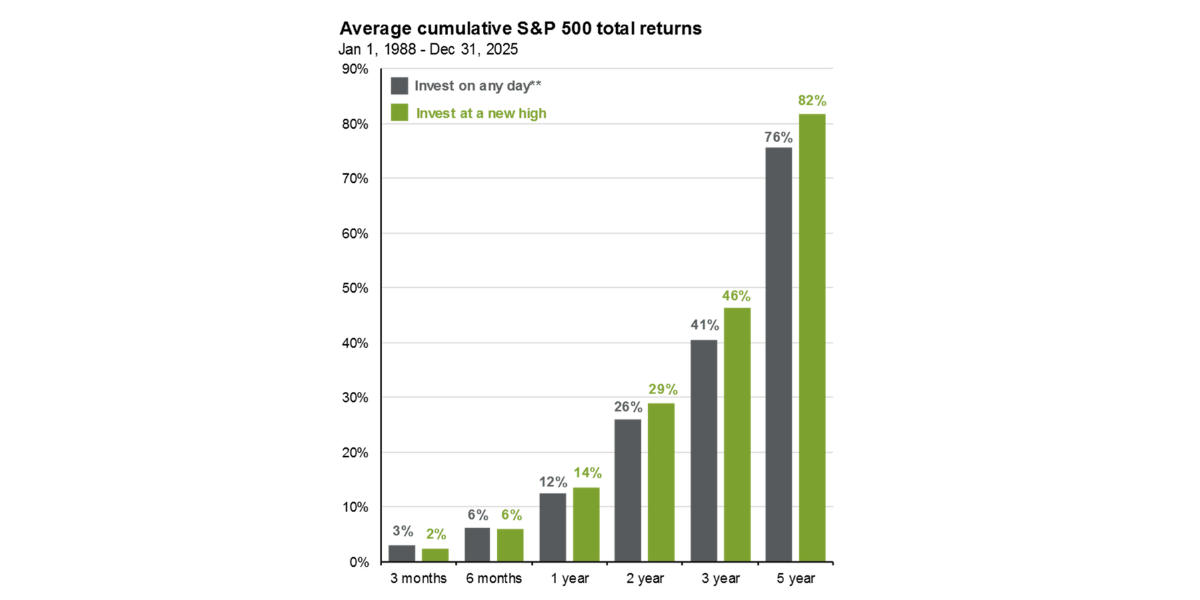
That said it's normal to see a market correction each year, the S&P 500 has averaged a 13.8% peak-to-trough decline annually since 1929, volatility is a feature not a bug. It's also worth noting that investing at all-time highs isn't as risky as it feels. History suggests that long-term returns from new highs have been surprisingly similar to overall returns.
Either way, we continue to believe dollar-cost averaging is a smart long-term approach: investing regularly, through the ups and downs, instead of trying to pick the perfect moment.
Source: JPMorgan Guide to the Markets. Past performance is not indicative of future results.
Where the World is Going: The strategy behind it all
In short, AI remains central to where we see the world going, but we think 2026 will be about the second-order effects — the infrastructure ripple, the less obvious winners, and the new risks that start to surface.
Our job is to:
- Stay focused on "where the world is going",
- Own businesses with real moats and aligned incentives,
- Be honest about our underperformers, and
- Stick to a disciplined, long-term process rather than chasing headlines.
Thank you again for trusting us with your savings and for being part of the Spaceship Voyager community. The path won't always be smooth, but we're excited about the destination — and we're committed to navigating the journey with you.
Our investment strategy
As a recap, Where the World is Going is our investment methodology that emphasises a company's growth potential, its trend, and its moat or competitive advantage. When we invest in companies in the Spaceship Universe and Spaceship Earth portfolios, we ensure they're poised to meet our expectations for:
Trend – Is the company riding a powerful wave of innovation, like AI. We look for businesses creating real value by tapping into transformative trends shaping the future.
Moat – Can it protect that value from the competition? A strong moat — think brand strength, massive scale, or loyal user networks — helps a company stay ahead and keep others from catching up. (Curious about how we assess moats? The Spaceship Voyager reference guide has you covered. )
Management – Great strategy needs great execution. We favour founder-led or owner-minded leaders who think long-term, protect their moat, and aren't afraid to build new ones along the way.
Performance – Even the best story needs strong numbers. We aim for new investments to meet a minimum Internal Rate of Return (IRR) of 15% annually — equivalent to doubling a company's value in five years.
Performance
Spaceship Earth Portfolio
The Spaceship Earth Portfolio returned 10.03% in the year ending 31 December 2025. It has returned an annualised performance of 11.14% pa since the Funded Date* of 12 November 2020 (61 months).
Spaceship Origin Portfolio
The Spaceship Origin Portfolio returned 10.04% in the year ending 31 December 2025. It has returned an annualised performance of 10.66% pa since the Funded Date* of 15 May 2018 (91 months).
Spaceship Universe Portfolio
The Spaceship Universe Portfolio returned 9.33% in the year ending 31 December 2025. It has returned an annualised performance of 14.52% pa since the Funded Date* of 15 May 2018 (91 months).
Spaceship Galaxy Portfolio
The Spaceship Galaxy Portfolio returned 5.47% in the year ending 31 December 2025. It has returned an annualised performance of 18.45% pa since the Funded Date* of 30 April 2024 (20 months).
Spaceship Explorer Portfolio
The Spaceship Explorer Portfolio returned 3.75% in the year ending 31 December 2025. It has returned an annualised performance of 9.60% pa since the Funded Date* of 30 April 2024 (20 months).
Past performance is not a reliable indicator of future performance and is provided for your information purposes only. Returns are net of fees, and not a projection.
The Funded Date represents the date on which the fund was substantially invested in accordance with its investment strategy.
Thank you
We trust this letter has provided a clear window into how our Where the World is Going process is applied in practice. We remain excited about the incredible innovations shaping the future — and we're committed to positioning your investments where growth is happening.
Some of our Spaceship Voyager portfolios invest in Cloudflare, Alphabet, Applovin, Taiwan Semiconductor, Constellation Energy, Broadcom, Nuix, Oracle, Tesla, Nvidia, Apple, and AMD at the time of writing.
Important! We're sharing with you our thoughts on the companies in which Spaceship Voyager invests for your informational purposes only. We think it's important (and interesting!) to let you know what's happening with Spaceship Voyager's investments. However, we are not making recommendations to buy or sell holdings in a specific company. Past performance isn't a reliable indicator or guarantee of future performance.