Just how concerned should we be that robots can potentially beat Usain Bolt in a foot race now?
Jump straight to
- What’s going on?
- What’s a humanoid robot?
- Are there any humans involved?
- What are they competing in?
- So, doing our jobs and beating us at sports?
- Why are you telling me this, Spaceship?
What’s going on?
More than 2,000 humanoid robots have been competing for the ultimate in robot glory: to be crowned winners of the second ever World Humanoid Robot Games.
Held in Beijing, China, the games last for five days and are run around the same time as the 2026 World Robot Conference, also held in Beijing, where companies show off their advances in the field.
The games themselves have been making headlines: some robots broke Usain Bolt’s sprinting record, while others crashed into a wall.
What’s a humanoid robot?
It’s a robot with arms and sometimes legs.
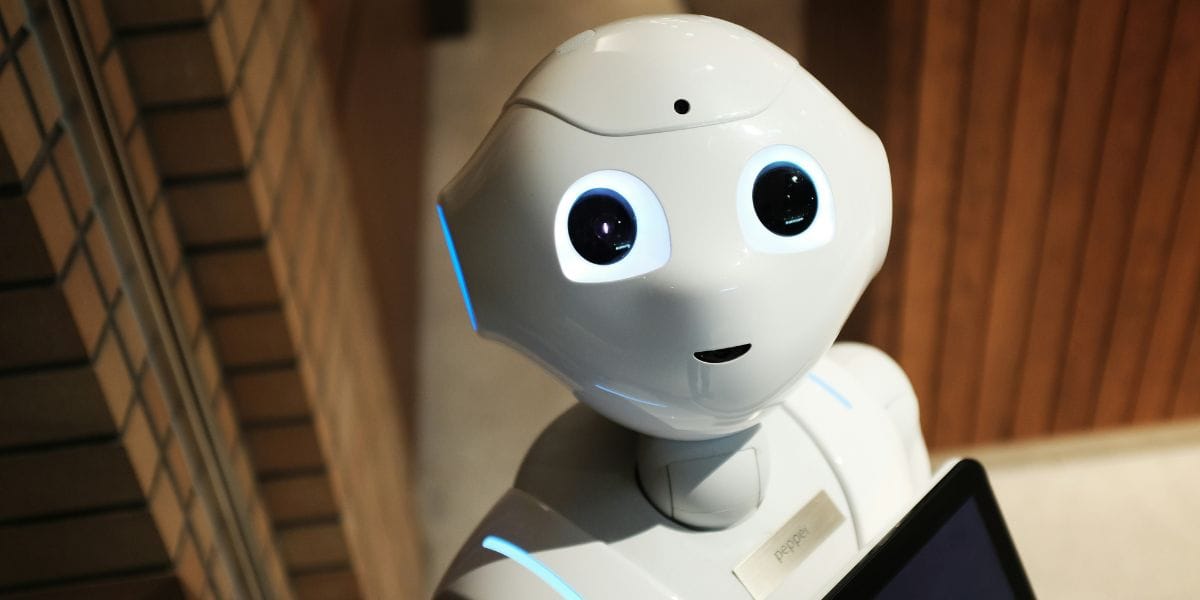
Most of them look a bit like Stormtroopers, but there’ve been efforts to make them look more friendly.
The humanoid robot Memo, for example, which costs Sunday Robotics $20,000 each to build, has eyes and a customisable baseball hat.
(These are intended to disguise cameras and make it feel less creepy even though creeping is its whole deal.)
https://www.instagram.com/reel/DSojcd9jvgP/
How’s that different from other robots?
The idea is that the world is already built for humans, so if we can build robots that are human shaped, they can use our existing infrastructure.
For example, use robot hands to unscrew jars of human food, open and stack dishwashers, or stack and move boxes.
Are there any humans involved?
The robots aren’t self-organising their own tournaments… yet.
Each robot has a team behind it - more than 600 teams are competing all up - and with representatives from sixteen different countries.
The games help foster the development of international standards.
The rules the robots are judged on can go some way to creating consensus amongst the robotics industry, as well as publicising where the field is up to.
There are companies involved, too.
Unitree, which recently listed on the Shanghai Stock Exchange a couple of days before the games launched, topped the medal table at last year’s games.
What are they competing in?
The events are broken into two categories: sports, and real-world scenarios.
Per Forbes, the robots compete across sports including track and field events, soccer, gymnastics, weightlifting, table tennis and more.
Some of the scenario events are based around retail scenarios, food & beverage scenarios, industrial scenarios, emergency scenarios such as fire rescue, and dexterous hand events such as power tool assembly and brick laying.
So, doing our jobs and beating us at sports?
John Koetsier for Forbes argues that the Humanoid Robot Games are a ‘market map’ that benchmarks the state of robotics and tracks which events can be completed autonomously, and which still require human intervention.
He notes that while the robots are being tasked with human jobs like unpacking boxes or sorting books, they’re not asked to do other human tasks like climbing stairs or ladders, collaborating with humans, or importantly, sticking to cost, energy, reliability, and uptime measures.
His hypothesis is that it’s a good approximation of what the industry is focusing on, and where it could be going next.
Why are you telling me this, Spaceship?
Apart from the fact that living in the robot era is pretty amazing and it’s fun to think about having robot friends, even if they might be a while away, our Spaceship Voyager portfolio companies are playing a role in the rise of the robots.
JP Morgan predicts robotics could be worth $2.5 trillion by 2035 - 25 times what it was worth in 2025.
Of course, nobody knows what the future holds, anything could happen in ten years, and this number is just their published guess.
Robotics is one of our Where the World is Going investment trends.
So we asked the team whether we should start saving up for robot butlers, or if there’s a different takeaway from the rise of the robots.
Here’s Sid Mehta, who keeps a close eye on robotics as an analyst for our Spaceship Voyager portfolios.
“A framework we like is to look at the humanoid robotics buildout is a three-layer stack — the brain (AI compute like Nvidia GPUs and TSMC's fabs that let machines perceive and decide), the bronze (the physical body — manufacturing and robotic hardware from companies like Tesla, Hyundai (who own Boston Dynamics), and the battery (the energy storage powering it all, from CATL to BYD) — and we've built exposure across all three.
In the Spaceship Universe Portfolio, brain exposure shows up through Nvidia, AMD, Broadcom, TSMC, SK Hynix, Samsung; bronze through Tesla; battery through CATL, Siemens Energy, Constellation Energy.
The Spaceship Earth Portfolio owns the same businesses besides Constellation Energy, and in addition owns BYD.
Then, there are the actual applications.
The reality is that while there has been a lot of incredible innovation and progress from large companies like Tesla, Hyundai and a whole range of smaller businesses, applications for humanoid robots are in early days.
We saw the market re-rate Hyundai last year, and subsequently sell the stock off along with the Korean market sell-off this year.
The challenge today is that there is little visibility on earnings from robotics, what we do see is that each country is developing a lot of the supply chain in their own trusted ecosystem and not just source the cheapest components which is a trend that is likely to continue.
But the innovation is real, we can see robots being used in manufacturing factories and it is a space we’re watching closely as it develops.”
Some of the Spaceship Voyager portfolios invest in Nvidia, TSMC, SK Hynix, Samsung, Tesla, CATL, Siemens Energy, Constellation Energy and BYD at the time of writing.
Want to learn more about the companies held in the Spaceship Voyager portfolios?
Get to know the Spaceship Voyager portfolios including portfolio information, risks, fees, TMD and PDS.
Important! We're sharing with you our thoughts on the companies in which Spaceship Voyager invests for your informational purposes only. We think it's important (and interesting!) to let you know what's happening with Spaceship Voyager's investments. However, we are not making recommendations to buy or sell holdings in a specific company. Past performance isn't a reliable indicator or guarantee of future performance.